- Gregg's Top Three Health Policy Articles
- Posts
- Gregg's Top Three Health Policy Articles
Gregg's Top Three Health Policy Articles
For the week of Jan 23-30, 2026

Gregg S. Margolis, PhD
January 30, 2026
If you can only read three things about health policy this week, I suggest...
The Top Three...
The Washington Post: The Cost Of Health Care, Not Food Or Rent, Is Now Americans’ Top Worry Yes, Americans are worried about their bills for groceries, housing and utilities. But their biggest pocketbook anxiety arises from the cost of health care, according to a new poll, and their rising concern is likely to affect this year’s midterm elections. Voters say that the issue will alter their election choices, with about three-quarters indicating that health care costs will affect their choices in November, according to the poll released Thursday by KFF, a nonpartisan health policy organization. (Whoriskey, 1/29)
Modern Healthcare: How Another Government Shutdown Would Impact Healthcare Once again, Medicare payments for telehealth and hospital-at-home care are at risk if Congress doesn't make a deal before Saturday. (McAuliff, 1/30)
The Wall Street Journal: Drop In Drug Overdoses Boosts U.S. Life Expectancy To All-Time High Life expectancy in the U.S. reached a record high in 2024 following a substantial decline of drug-overdose deaths, according to figures released by the federal government Thursday. The life expectancy at birth for the average American was 79 years old in 2024, up 0.6 year from the year prior, according to a report from the Centers for Disease Control and Prevention’s National Center for Health Statistics. The increase signals a rebound from declines in life expectancy during the coronavirus pandemic and progress in combating the opioid crisis. (Calfas, 1/29)
For a Deeper Dive...
CNN: Obamacare Enrollment Drops After Enhanced Premium Subsidies Expire More than a million fewer people have signed up for Affordable Care Act coverage for 2026, according to federal data released Wednesday. The drop comes after the expiration of the enhanced federal premium subsidies caused monthly payments to skyrocket for many enrollees. (Luhby, 1/28)
Undark: At NIH, A Power Struggle Over Institute Directorships Deepens When a new presidential administration comes in, it is responsible for filling around 4,000 jobs sprinkled across the federal government’s vast bureaucracy. These political appointees help carry out the president’s agenda, and, at least in theory, make government agencies responsive to elected officials. Some of these roles — the secretary of state, for example — are well-known. Others, such as the deputy assistant secretary for textiles, consumer goods, materials, critical minerals & metals industry & analysis, are more obscure. (Schulson, 1/29)
NBC News: Many CDC Databases Are Not Being Updated, Most Related To Vaccines, Study Finds Nearly half of the databases that the Centers for Disease Control and Prevention used to update regularly — surveillance systems that tracked public health information like Covid vaccination rates and hospitalizations for respiratory syncytial virus — have been paused without explanation, according to new research. The findings, published Monday in the journal Annals of Internal Medicine, indicate that at the start of 2025, the CDC maintained 82 databases that were updated at least monthly. But by the end of October, the study found, 38 had gone stale, with 34 showing no new entries at all in the previous six months. (Bendix, 1/26)
NBC News: Many ACA Enrollees Switched To Cheaper Bronze Health Care Plans. Here's Why That Could Be Risky Kate Bivona and her husband don’t know what they would do if either gets seriously sick or injured. Until recently, that wasn’t the case. But beginning in January, the monthly cost of her Affordable Care Act insurance jumped by about $300 — making it too expensive for them to afford. Bivona and her husband dropped down to a bronze plan, cutting their bill by more than half but leaving them with an $18,000 annual deductible. “We would have to take out a loan,” said Bivona, a 37-year-old musician in Arizona. “We don’t have that kind of money, maybe a couple of thousand dollars in savings.” (Lovelace Jr., 1/27)
KFF Health News: Doctors Increasingly See AI Scribes In A Positive Light. But Hiccups Persist When Jeannine Urban went in for a checkup in November, she had her doctor’s full attention. Instead of typing on her computer keyboard during the exam, Urban’s primary care physician at the Penn Internal Medicine practice in Media, Pennsylvania, had an ambient artificial intelligence scribe take notes. At the end of the 30-minute visit, Urban’s doctor showed her the AI summary of the appointment, neatly organized into sections for her medical history, the physical exam findings, and an assessment and treatment plan for her rheumatoid arthritis and hot flashes, among other details. (Andrews, 1/27)
For the Visual Among Us...


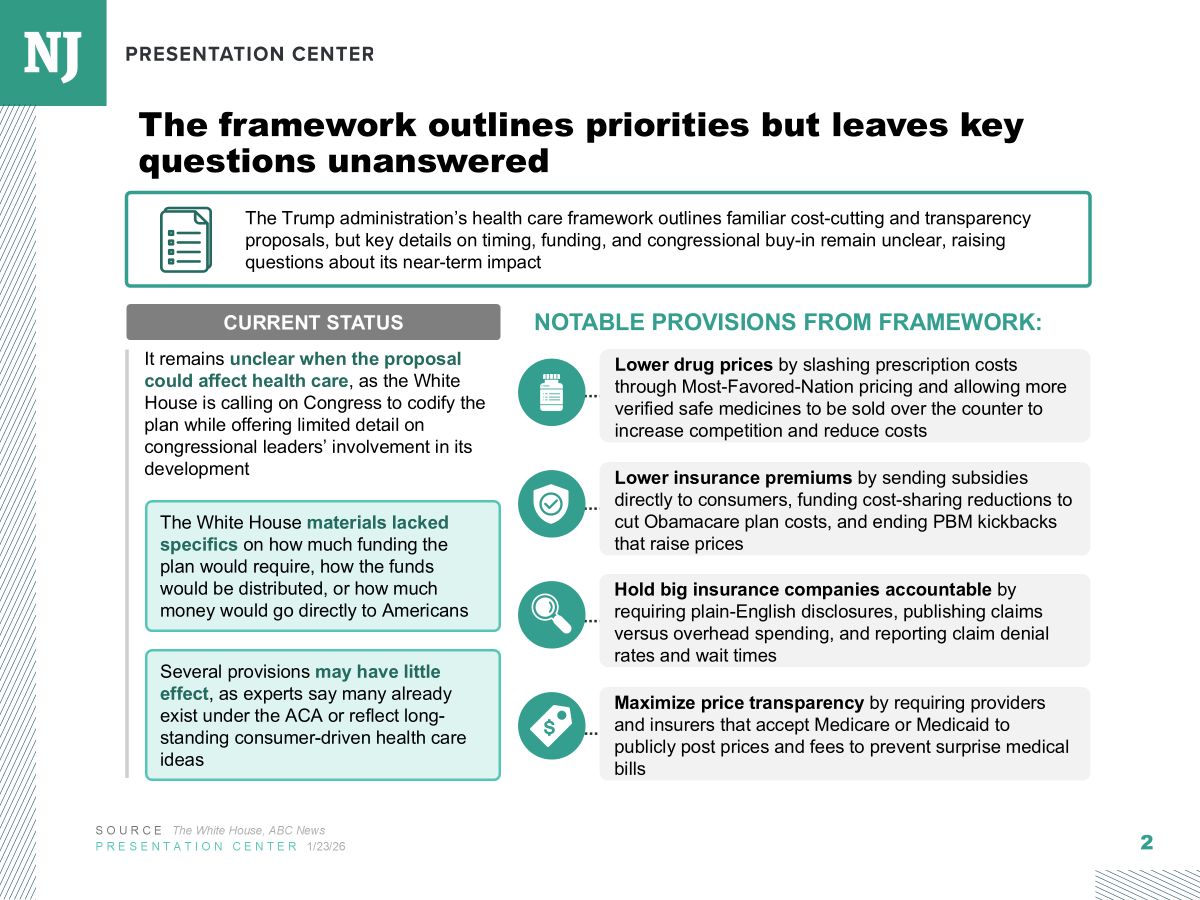
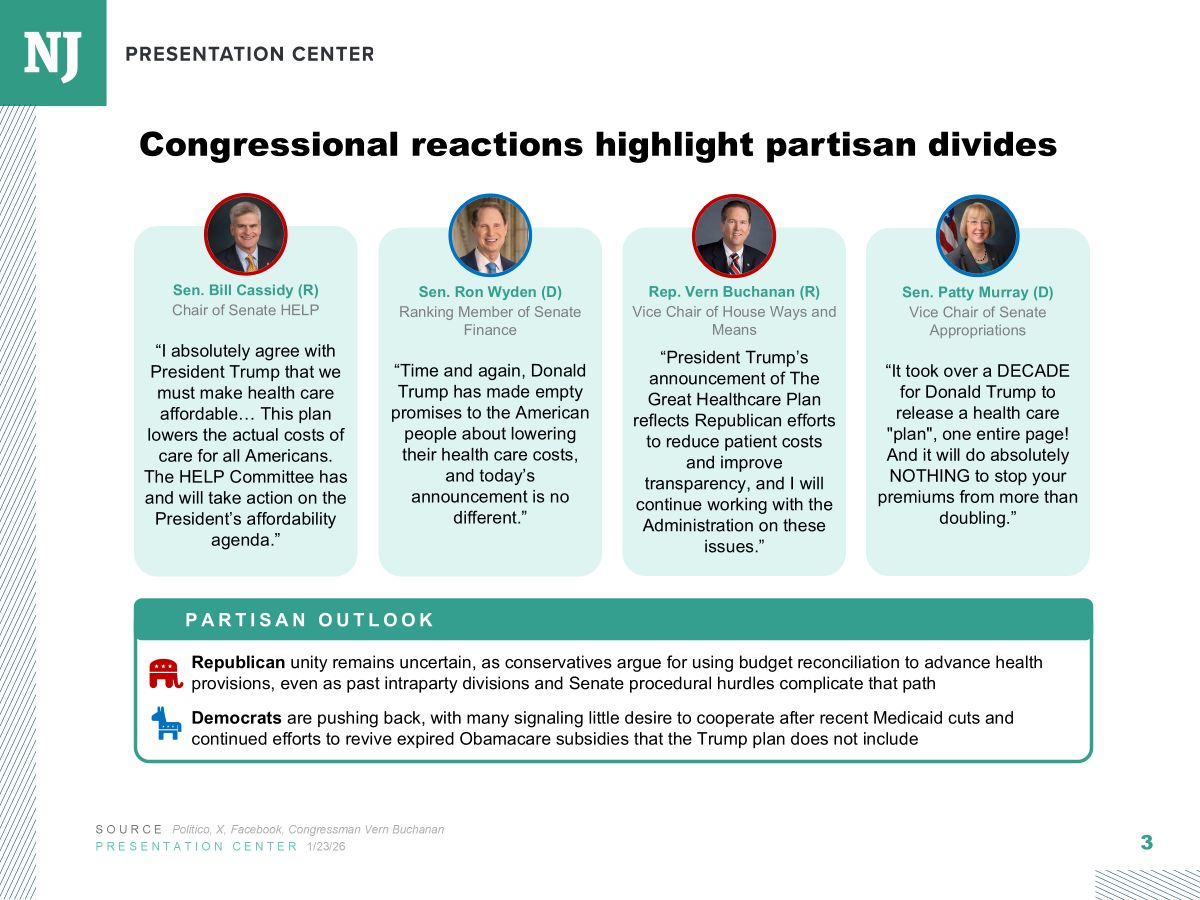
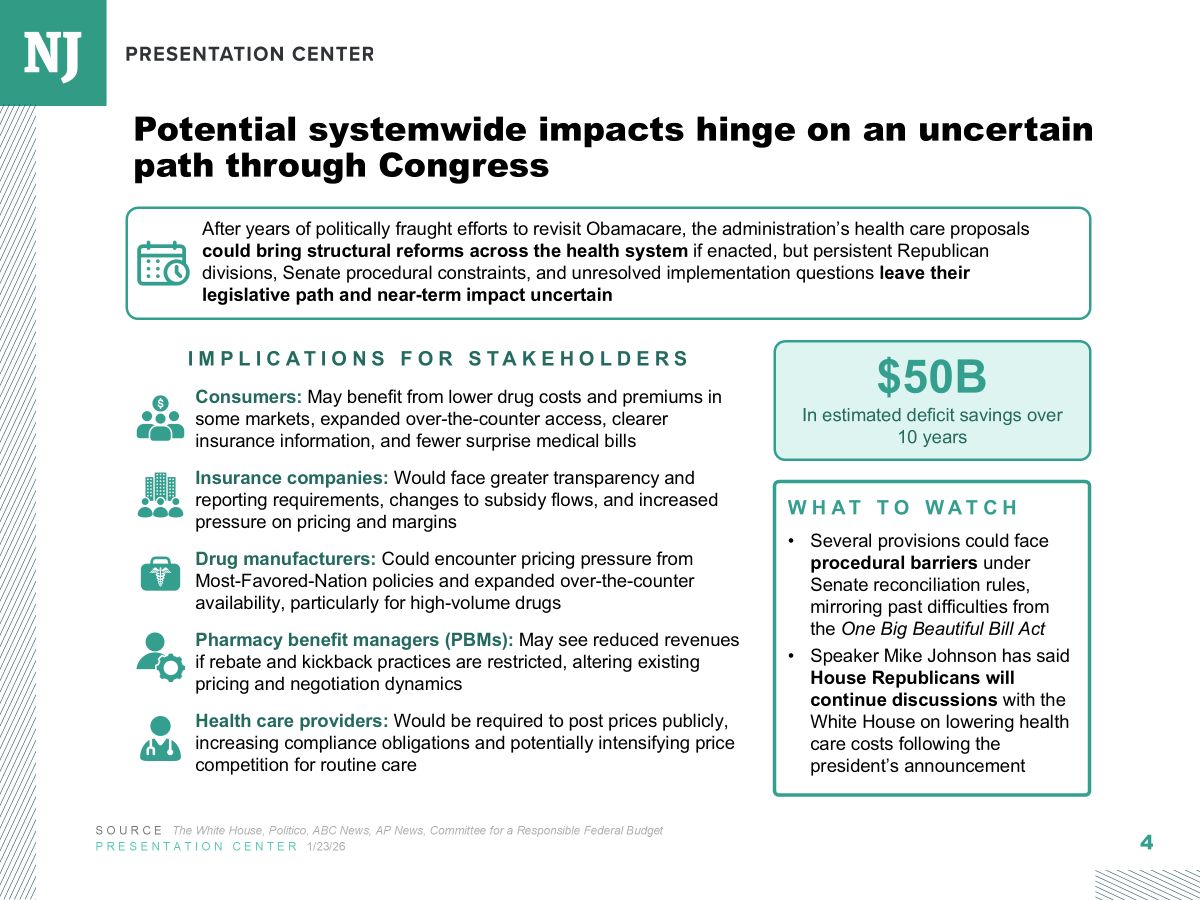

A few years ago I started a weekly e-mail for friends and colleagues who want to keep up on major federal health policy developments but did not have time to plod through all the minutiae--they were busy doing important things like running organizations and taking care of patients! Much to my surprise, it became pretty popular. I have now converted to a weekly newsletter format so you can manage your own subscription preferences and forward to others that might be interested.
These summaries represent my judgement on health policy issues that may not on the front pages, but are relevant to clinicians, administrators, and educators. I monitor many news sources and clipping services to identify content for this newsletter and I try hard to be as factual, balanced, and non-partisan as possible. While the articles are written by others (with credit attributed), the choice of what to include is entirely mine. If you are interested in receiving a daily summary of health policy news, you might consider signing up for the KHN Morning Briefing. If you enjoy podcasts, I suggest What the Health? and Tradeoffs.
-Gregg S. Margolis, PhD