- Gregg's Top Three Health Policy Articles
- Posts
- Gregg's Top Three Health Policy Articles
Gregg's Top Three Health Policy Articles
For the week of Feb 13-20, 2026

Gregg S. Margolis, PhD
February 20, 2026
If you can only read three things about health policy this week, I suggest...
The Top Three...
The Washington Post: U.S. Considers Building Pricey Alternative To World Health Organization After pulling out of the World Health Organization, the Trump administration is proposing spending $2 billion a year to replicate the global disease surveillance and outbreak functions the United States once helped build and accessed at a fraction of the cost, according to three administration officials briefed on the proposal. The effort to build a U.S.-run alternative would re-create systems such as laboratories, data-sharing networks and rapid-response systems the U.S. abandoned when it announced its withdrawal from the WHO last year and dismantled the U.S. Agency for International Development, according to the officials, who spoke on the condition of anonymity to share internal deliberations. (Sun and Bogage, 2/19)
Politico: Jay Bhattacharya Named Acting CDC Director Jay Bhattacharya, the head of the National Institutes of Health, will become acting director of the Centers for Disease Control and Prevention following the dismissal last week of Jim O’Neill, according to a White House official and an administration official. President Donald Trump will name O’Neill to lead the National Science Foundation, one of the officials said. (Haslett, Lim and Gardner, 2/18)
Bloomberg: CMS Head Oz Vows Continued Vaccine Coverage, Urges Measles Shots Mehmet Oz, head of the US Centers for Medicare and Medicaid Services, pledged continued insurance coverage for all recommended vaccinations in the country and urged people to get the measles shot as infections skyrocket. His comments come as the Trump administration remakes the nation’s approach to immunizations by promoting personal choice and backing away from once-universal endorsements of shots that have controlled deadly disease outbreaks. Changes to the vaccine schedule have added to mounting confusion over which vaccines will be covered by government programs that often pay for childhood shots. (Nix and Muller, 2/17)
For a Deeper Dive...
Stat: FDA Reverses Course, Agrees To Review Moderna’s Flu Vaccine The Food and Drug Administration reversed course and told Moderna it would review its application for a new flu vaccine, the company announced Wednesday. (Lawrence, 2/18)
AP: FDA Drug Approvals: Makary And Prasad Say One Study Will Be Enough The Food and Drug Administration plans to drop its longtime standard of requiring two rigorous studies to win approval for new drugs, the latest change from Trump administration officials vowing to speed up the availability of certain medical products. Going forward, the FDA’s “default position” will be to require one study for new drugs and other novel health products, FDA Commissioner Dr. Marty Makary and a top deputy, Dr. Vinay Prasad, wrote in a New England Journal of Medicine piece published Wednesday. (Perrone, 2/18)
Modern Healthcare: National Specialty Care Access Coalition To Target Rural Patients More than 20 health systems have teamed up in a bid to use technology to improve access to care in rural and underserved areas. The National Specialty Care Access Coalition, which launched Wednesday, will prioritize standardizing care models, reforming policy and deploying pilots to speed innovation, a news release said. The model enables shared learning and a unified perspective, among other advantages, according to its website. (DeSilva, 2/18)
Politico: Why Congress Failed To Reach An Obamacare Deal Brian Fitzpatrick didn’t expect to find himself in the middle of a political brawl over health policy. The Pennsylvania Republican and former FBI agent doesn’t count the legislative area as a pillar of his portfolio. But early last fall, he joined a fledgling group of lawmakers incensed that House GOP leaders were doing nothing to extend enhanced Obamacare subsidies before they expired. The lack of action, they knew, would send health insurance premiums soaring come January 1. (King and Levien, 2/17)
The Hill: Top Republican Eyeing FDA Overhaul Sen. Bill Cassidy (R-La.) on Tuesday unveiled his proposal for modernizing the Food and Drug Administration (FDA), calling on the agency to reform some of its practices and embrace innovations in order to get more products approved for patients. In the report titled “Patients and families: Building the FDA of the future,” Cassidy, chair of the Senate Committee on Health, Education, Labor, and Pensions, lamented that “unnecessary bottlenecks slow patients and consumers getting the products they need.” (Choi, 2/17)
NBC News: At National Institutes Of Health, Many Director Positions Sit Open The National Institutes of Health has, in large part, managed to withstand the Trump administration’s attempts to slash its budget and upend how it distributes grants, thanks to decisions from the courts and Congress. But the agency now faces a growing vacuum in leadership in its top ranks — one that offers the administration a highly unusual opportunity to reshape NIH to its vision. Of the 27 institutes and centers that make up NIH, 16 were missing permanent directors as of Friday, when staff received news of the latest departure. (Bendix, 2/15)
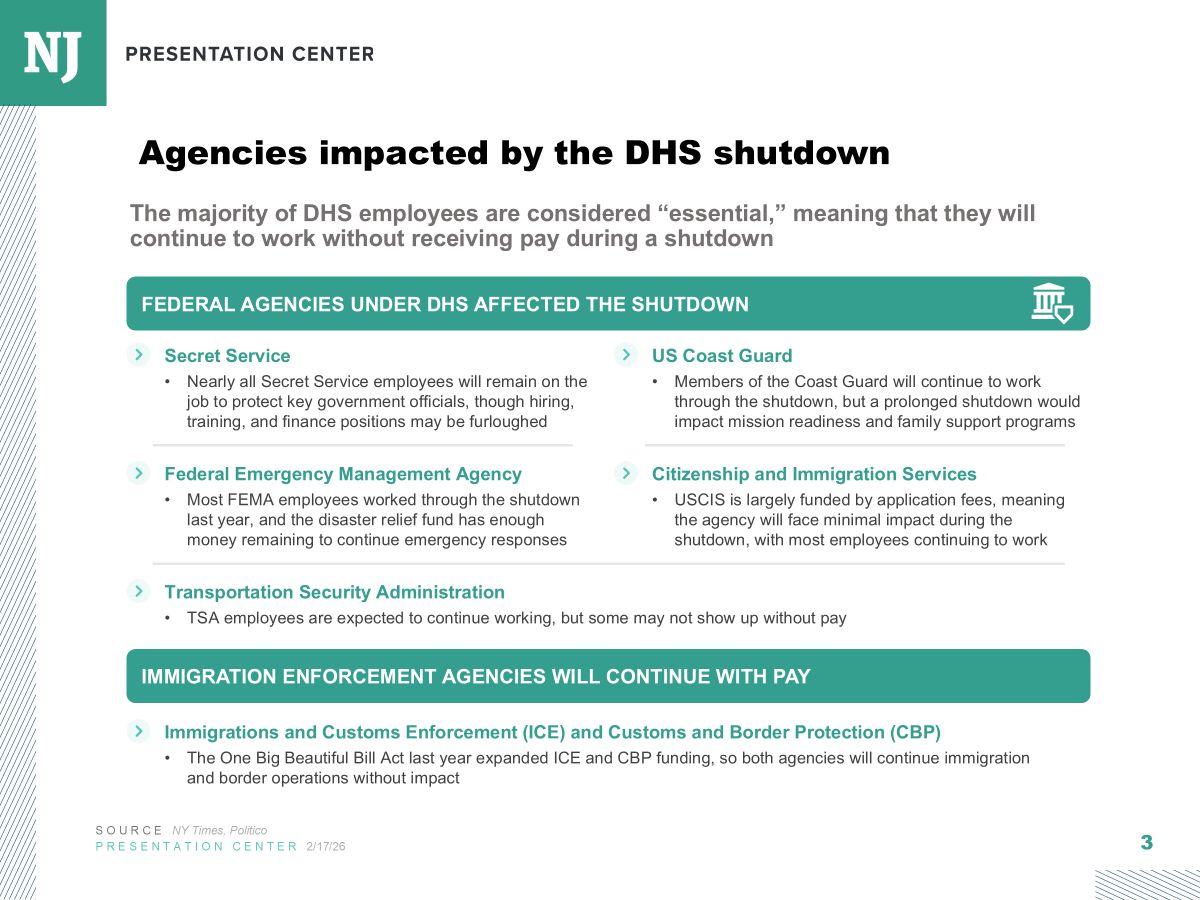
For the Visual Among Us...



A few years ago I started a weekly e-mail for friends and colleagues who want to keep up on major federal health policy developments but did not have time to plod through all the minutiae--they were busy doing important things like running organizations and taking care of patients! Much to my surprise, it became pretty popular. I have now converted to a weekly newsletter format so you can manage your own subscription preferences and forward to others that might be interested.
These summaries represent my judgement on health policy issues that may not on the front pages, but are relevant to clinicians, administrators, and educators. I monitor many news sources and clipping services to identify content for this newsletter and I try hard to be as factual, balanced, and non-partisan as possible. While the articles are written by others (with credit attributed), the choice of what to include is entirely mine. If you are interested in receiving a daily summary of health policy news, you might consider signing up for the KHN Morning Briefing. If you enjoy podcasts, I suggest What the Health? and Tradeoffs.
-Gregg S. Margolis, PhD